
|
Quantity
|
Total
|
||
|
|
|||
|
|
|||
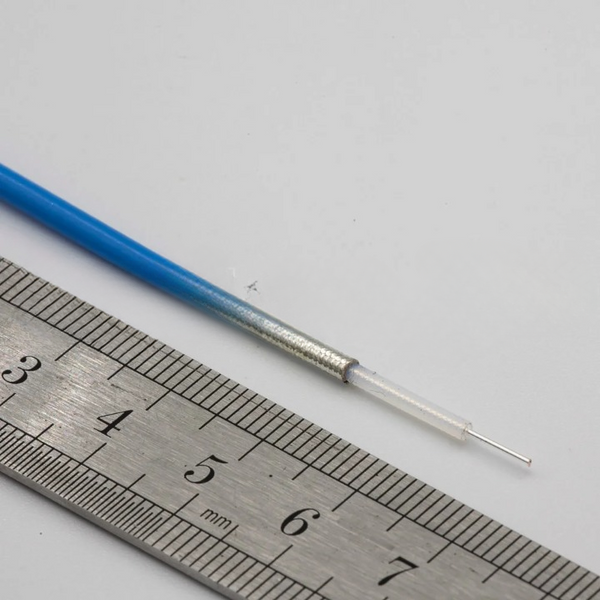
SSF-85 Coaxial cable with tinned outer braid Ø2.6 mm is a semi-flexible high-frequency conductor with a 50-ohm impedance, designed for transmitting radio frequency signals with minimal losses. Thanks to its solid tinned braid, this cable perfectly retains its set shape after bending, making it a highly demanded solution for routing antenna lines inside the compact housings of electronic equipment.
The outer diameter of 2.6 mm allows the cable to be routed in tight layouts of drones and communication systems without the risk of breaking the center conductor. The tinned coating of the shield not only provides a reliable level of shielding against external electromagnetic interference but also guarantees convenient soldering directly to circuit boards or connectors such as SMA, U.FL, or MMCX without the use of aggressive fluxes.
🫡 We Are a Team of Veterans
We choose the SSF-85 Coaxial cable with tinned outer braid Ø2.6 mm for creating reliable pigtails and internal connections between video transmitters and antennas on FPV platforms. Standard flexible wires often fray or change their characteristics under the influence of intense vibrations, whereas the semi-flexible structure of the SSF-85 is firmly held in a given position. This gives confidence that the radio channel will operate stably even after hard landings or active maneuvering of the aircraft during complex tasks.
⚙️ Technical Specifications
| Parameter | Value |
| Model | SSF-85 |
| Cable type | Semi-Flexible Coaxial |
| Impedance | 50 Ohms |
| Outer diameter | 2.6 mm |
| Shielding | Tinned copper braid |
| Center conductor | Silver-plated copper |
| Dielectric | PTFE (Teflon) |
| Operating frequency range | Up to 18 GHz |
| Operating temperature range | From −55°C to +125°C |
Commentary / Comments
The key advantage of the SSF-85 cable lies in the combination of excellent radio frequency performance with the capability of rigid spatial fixation. The PTFE dielectric withstands significant temperatures during intense soldering, preventing the center conductor from shorting to the shield, which frequently occurs when installing cheaper alternatives. The operating frequency range of up to 18 GHz guarantees signal transmission without distortion both on classic 5.8 GHz frequencies and in specific non-standard control bands.
The absence of classic external PVC insulation in favor of a solid tinned shield allows grounding to be soldered along the entire length of the conductor, creating a reliable ground connection and additional heat dissipation from powerful video transmitters. This is particularly relevant when designing custom communication systems, where every millimeter of free space matters, and the level of interference must be reduced to an absolute minimum.
🎯 Target Audience / Suitable For
FPV drone assembly engineers and communication system developers receive a reliable conductor for creating custom antennas and pigtails that require rigid fixation within the aircraft's frame. The semi-flexible structure allows the transmission line to be routed while considering all the structural features of the platform, avoiding friction against moving parts. The tinned shield significantly simplifies the soldering process to connectors and printed circuit boards, providing stable contact without overheating the elements. The high temperature stability of the dielectric guarantees that the cable will not lose its physical properties during installation using powerful soldering stations. Furthermore, excellent shielding performance minimizes the impact of the drone's internal interference on the sensitive radio channel.
Electronic equipment repair technicians and electronic warfare specialists use this cable to restore damaged high-frequency paths in portable and stationary devices. The operating frequency range fully covers the needs of most modern data transmission systems, including specific jamming and radio reconnaissance bands. The cable's ability to remember its shape after bending allows it to accurately replicate the complex factory geometry of communication lines inside a densely packed housing. This ensures impedance stability and prevents the emergence of parasitic standing waves in critical sections of the circuit. The lack of soft external insulation also promotes better heat dissipation when densely mounted next to hot board components.
Military operators and UAV unit technicians conducting field modifications of equipment find in this cable a durable solution for amplifying the video signal and control link. Thanks to reliable shielding, the conductor effectively protects the useful signal from the impact of powerful onboard interference and external electromagnetic pulses. The ability to quickly form the required bending angle without the use of special tools significantly saves time during urgent equipment repairs. The resistance of the materials to temperature fluctuations allows the restored equipment to be operated in harsh climatic conditions without sacrificing communication range. The durability of the connections made with this cable directly impacts the overall success of extended observation missions.