
|
Quantity
|
Total
|
||
|
|
|||
|
|
|||
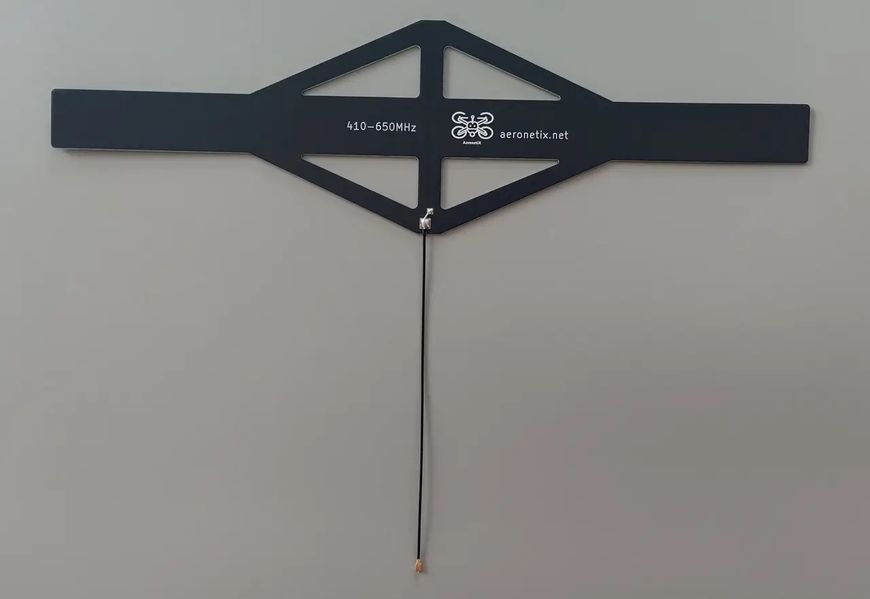
Wideband dipole receiving antenna for FPV drone control 410–650 MHz Aeronetix, 15 cm cable
Wideband dipole receiving antenna for FPV drone control 410–650 MHz Aeronetix, 15 cm cable is designed for stable reception of control signals in the low-frequency 410–650 MHz range. Linear polarization and a wideband design allow operation with different control systems without the need for precise tuning to a single frequency.
The compact and flexible design with a 15 cm cable ensures convenient installation in receiver modules without adding extra load to the platform. The antenna is optimized for stable performance in interference-prone environments and provides reliable signal reception over medium and long distances.
We are a team of veterans
We work with control systems in real-world conditions where link stability directly affects platform control. We understand the importance of reliable reception, especially in lower frequency bands.
We select antennas based on specific control systems and operating conditions. Our approach is focused on practical use, which is why we offer solutions that deliver consistent results.
Technical specifications
| Parameter | Value |
|---|---|
| Type | Dipole receiving antenna |
| Frequency range | 410–650 MHz |
| Polarization | Linear |
| Design | Wideband |
| Cable length | 15 cm |
| Cable type | Flexible coaxial |
| Application | FPV drone control |
| Manufacturer | Aeronetix |
Comment / comments
The wideband design allows the antenna to be used across different configurations without strict frequency matching. This is useful when switching control systems or testing multiple setups.
The low-frequency range provides better signal penetration through obstacles compared to higher frequency systems. This makes the antenna effective in complex environments with interference and terrain challenges.
Who it is suitable for
Military
Suitable for control systems where signal stability and resistance to interference are critical. Provides reliable reception even in complex terrain. Enables maintaining control over medium and long distances. Used in mobile and stationary systems. Suitable for tasks where control link reliability is essential.
FPV operators and technical units
Suitable for receivers operating in the 400–600 MHz range. Provides stable signal when properly installed. Used in various system configurations. Offers flexibility in setup. Suitable for operation in challenging environments.
Engineers and system developers
Used in testing and development of control systems. Allows working across different frequencies without changing the antenna. Suitable for lab and field testing. Ensures stable and repeatable results. Used in prototyping.
Control and data transmission systems
Suitable for receiving modules in various technical applications. Provides stable signal when properly matched. Used in mobile systems. Enables operation in interference-heavy environments. Suitable for specialized configurations.
Enthusiasts and experimenters
Suitable for building custom control systems. Enables work across a wide frequency range. Used for testing and tuning. Provides stable results when properly configured. Offers flexibility in system design.