
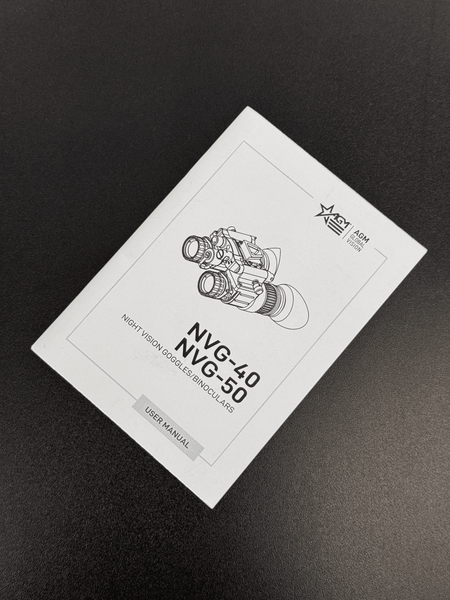
The AGM NVG40/50 Manual is a detailed and fully localized printed operation guide for the AGM NVG-40 and NVG-50 series dual-channel night vision devices. This document transforms the manufacturer's complex technical documentation into a clear sequence of actions for the user. The reference book contains comprehensive data on the proper adjustment of interpupillary distance, objective lens focusing, diopter management, and the use of the built-in infrared illuminator in total darkness.
The printed edition is produced on durable waterproof paper that reliably withstands intensive use in field conditions, even during precipitation. The convenient pocket-sized format allows you to always keep the manual at hand, providing quick access to information on battery replacement, optics cleaning, and basic troubleshooting directly at the mission site without relying on electronic devices.
Technical Specifications
| Parameter | Value |
| Publication type | User manual |
| Language | Ukrainian |
| Compatibility | AGM NVG-40 and AGM NVG-50 binoculars |
| Format | A5 (pocket size) |
| Page material | Waterproof thick paper |
| Cover | Soft with lamination |
| Content | Setup, maintenance, mounting, troubleshooting |
Commentary / Comments
The key advantage of this edition lies in the precise localization of specific technical terms, which eliminates double interpretation of factory guidelines. Many users ruin expensive equipment precisely due to incorrect focusing or ignoring the rules of protection against bright light sources, which are described in detail in this manual. The reference book explains the operating principles of the binocular step by step, helping to significantly extend the service life of sensitive image intensifier tubes.
The compact dimensions guarantee the constant presence of technical support directly in a pouch or gear pocket. Detailed explanations regarding working with various types of mounts and helmets allow the operator to independently adjust the tilt angle and eye relief. Proper spatial positioning of the device helps avoid cervical spine strain during prolonged night observation and active movement.
Target Audience / Suitable For
Military personnel of infantry and reconnaissance units receive a reliable knowledge source for the correct operation of binocular optics in combat conditions. The reference book deeply reveals all the nuances of adjusting the interpupillary distance and diopter rings for comfortable operation with both eyes without losing peripheral control. A proper understanding of the principles of protection against light exposure guarantees the preservation of the expensive device during sudden flashes or working near bright light sources. The compact format of the manual allows constantly carrying it in a gear pocket and instantly referring to it when operational questions arise while on duty. Understanding the operation algorithms of the integrated infrared illuminator allows remaining invisible to the enemy while functioning effectively in complete darkness.
Instructors of training centers can use this material as a basic textbook to teach cadets the fundamentals of working with modern night vision gear. The structured text with clear action algorithms significantly facilitates the process of explaining complex optical nuances to soldiers without prior experience. The presence of detailed sections on regular maintenance and typical malfunctions allows teaching personnel to independently care for the entrusted property in field conditions. The translated professional terminology completely removes the language barrier and accelerates material assimilation by training groups. A properly established knowledge base at the training stage directly minimizes the number of damaged devices in the units.
Technical gear maintenance specialists find exact specifications in the reference book regarding the compatibility of various batteries and safe protocols for cleaning lenses from debris. The document helps correctly integrate devices onto different helmet types, avoiding damage to brackets, locking mechanisms, or threaded connections. Understanding the manufacturer's clear recommendations for long-term equipment storage allows organizing proper inventory of optics in warehouses. This directly reduces the property write-off rate caused by negligence, corrosion, or violation of temperature conditions. The presence of complete device diagrams accelerates the process of defect identification and basic equipment repair before issuance to soldiers.